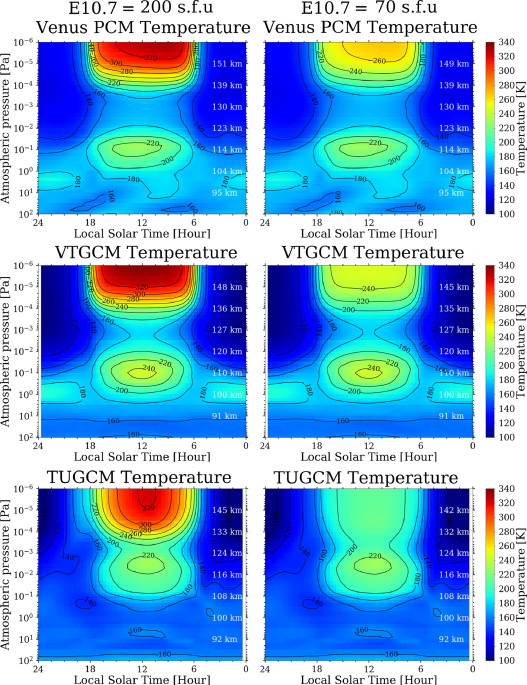



In the context of future Venusian missions, it is crucial to improve our understanding of Venus upper atmosphere through 3D modeling, notably for spacecraft orbit computation. A recent study led by our group (Martinez et al., 2026) compares three General Circulation Models (GCMs) of the Venusian atmosphere up to the exosphere: the Venus Planetary Climate Model (Venus PCM), the Venus Thermospheric Global Model (VTGCM) and the Tohoku University GCM (TUGCM), focusing on their nominal simulations (e.g. composition, thermal structure and heating/cooling rates). Similarities and discrepancies among them are discussed in this paper, together with data-models comparison. The nominal simulations analyzed in this study fail to accurately reproduce the daytime observations of Pioneer Venus, notably overestimating the exospheric temperature. This is linked to an underestimation of the atomic oxygen (O) abundance in the three GCMs, and suggests the need of additional O production in the thermosphere. The selection of solar spectrum is also the main reason for the discrepancies between the models in terms of temperature dependence on solar activity. A list of recommendations is proposed aiming at improving the modeling of Venus’ upper atmosphere, among them: 1. Standardize the EUV-UV solar spectrum input. 2. Update the near-infrared heating scheme with Venus Express-Era data. 3. Reassess Radiative cooling schemes. 4. Investigate the underestimated atomic Oxygen abundance.
The paper can be accessed at: https://www.sciencedirect.com/science/article/pii/S001910352500449X