


A new study led by members of GAPT, recently published in Space Science Reviews, provides the most comprehensive map to date of the Martian homopause, the critical boundary where the planet’s atmosphere transitions from being a well-mixed gas to a region where gases separate by their weight.
In the lower atmosphere, turbulent mixing keeps all chemical species evenly distributed. However, above the homopause, molecular diffusion takes over, allowing lighter elements to rise toward the "edge" of space where they can more easily escape. Understanding exactly where this boundary lies and how it moves is essential to reconstruct the history of atmospheric escape on Mars.
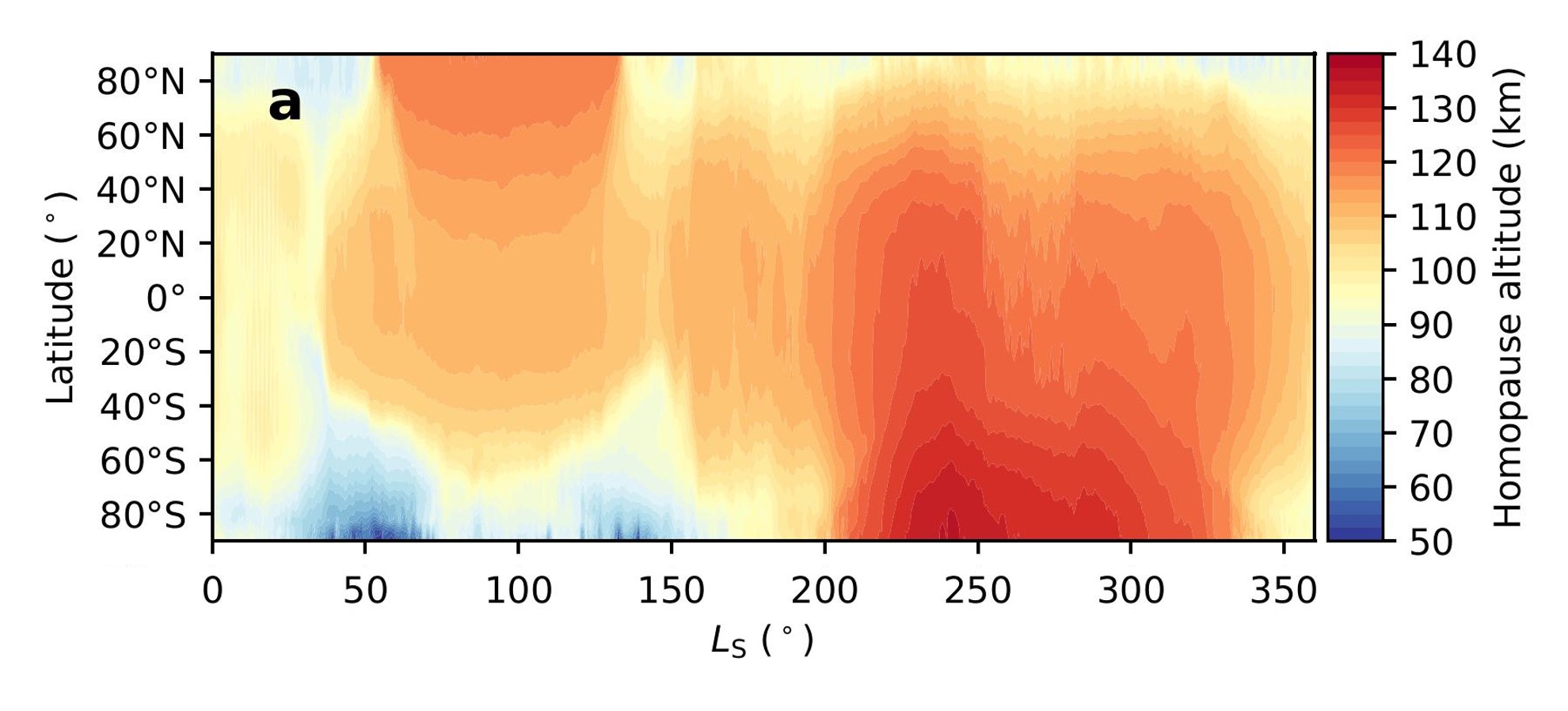
This study utilises simulations from the Mars Planetary Climate Model (PCM) to explore the modes of variability of this boundary. Seasonally, the homopause sits at maximal altitudes of around 120-140 km during summer, when the increased solar insolation produces an atmospheric expansion and strengthens the atmospheric circulation and mixing. Similarly, the simulations also reveal variations across the day, where the homopause rises and falls by 5 to 15 km, peaking in the warm afternoon. Finally, this study also suggests that dust storms can raise the altitude of the homopause by 10-20 km, depending on the strength of the events.
To ensure the accuracy of these simulations, this study also compares the model results with real-world observations from two major orbital missions: NASA’s MAVEN (using the NGIMS instrument) and ESA’s ExoMars Trace Gas Orbiter (using the ACS instrument). The comparison confirmed that the model effectively captures the overall seasonal and latitudinal trends of the Martian atmosphere, but the observations appear to reveal stronger variability that is underestimated in the model.
This work represents a significant step forward in our ability to model the complex dynamics of the Martian upper atmosphere and provides a clearer picture of how the Red Planet interacts with the space environment.
Full reference: Alday, J., González-Galindo, F., Belyaev, D.A. et al. Variability of the Martian Homopause: Insights from Global Climate Modelling and Empirical Estimates. Space Sci Rev 222, 57 (2026). https://doi.org/10.1007/s11214-026-01309-3